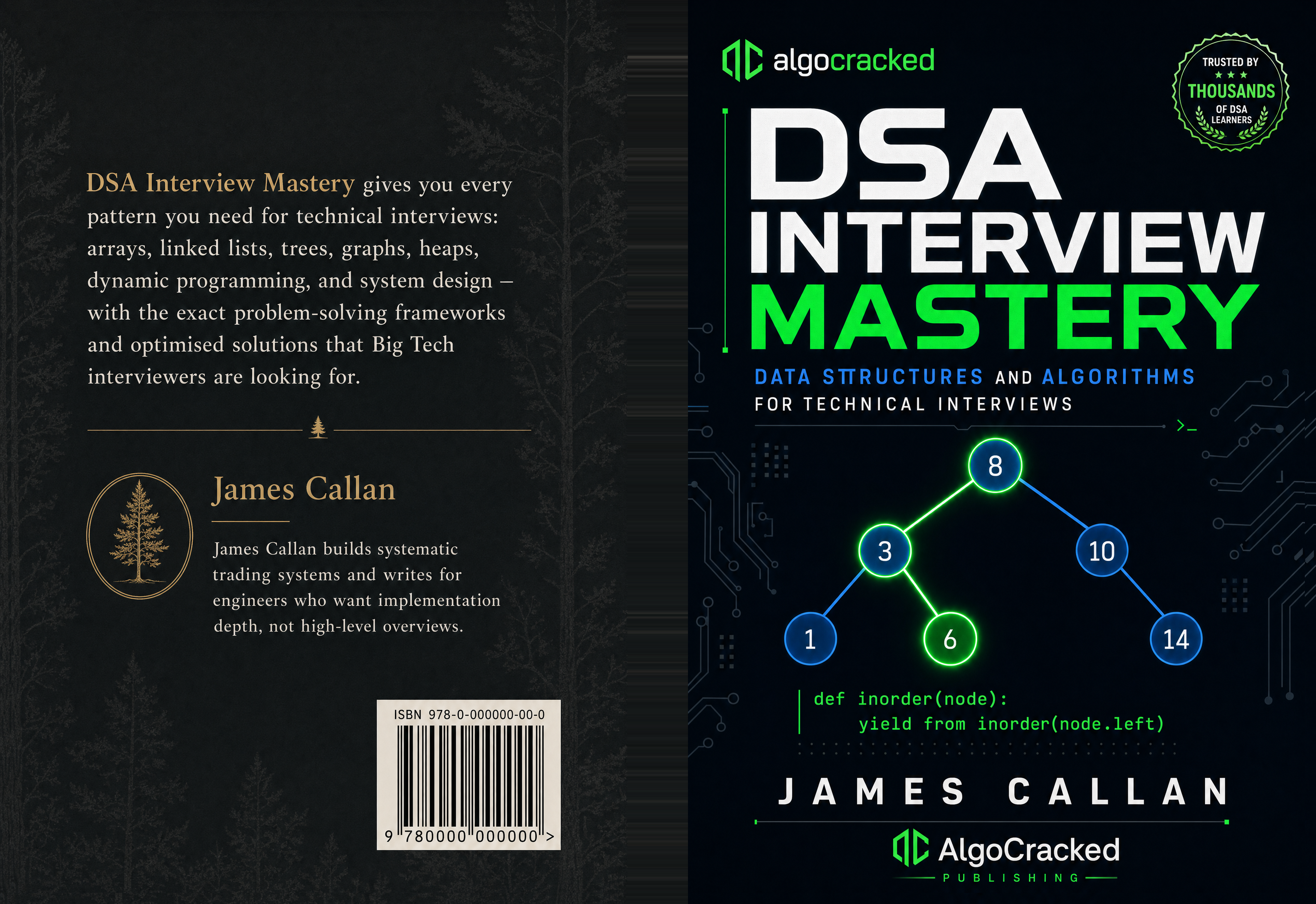
BOOK
Data Structures and Algorithms for Top-Tier Tech Interviews
You will internalize the 15 core algorithmic patterns that cover 90%+ of interview questions, build reliable problem-solving frameworks.
This book teaches you to solve technical interview problems through reusable patterns, precise complexity reasoning, and strong communication under pressure. By the end, you will have a personal interview playbook covering core patterns, explanation templates, debugging checklists, and graded practice sets.
Built for
A practical guide for software engineers preparing for technical interviews at FAANG-level companies who want a systematic, pattern-based approach rather than memorizing 500 LeetCode problems.
What makes it useful
You will internalize the 15 core algorithmic patterns that cover 90%+ of interview questions, build reliable problem-solving frameworks, and develop the communication skills that turn correct solutions into strong-hire signals.
THE DIFFERENCE
A personal interview playbook covering core patterns, explanation templates, debugging checklists, and graded practice sets.
Apply the practical framework in Interview Mindset and Complexity Reasoning - Establish how strong candidates think aloud, reason about complexity, and turn vague prompts into structured solution plans..
Apply the practical framework in Two Pointers and Sliding Window - Turn ordered traversal into a pattern the reader can recognize quickly under interview pressure..
Apply the practical framework in Trees, Recursion, and Traversal Patterns - Establish recursive thinking, tree traversal templates, and the discipline of passing state through call stacks carefully..
THE FULL BRIEF
This book teaches you to solve technical interview problems through reusable patterns, precise complexity reasoning, and strong communication under pressure. By the end, you will have a personal interview playbook covering core patterns, explanation templates, debugging checklists, and graded practice sets.
This book teaches you to solve technical interview problems through reusable patterns, precise complexity reasoning, and strong communication under pressure. By the end, you will have a personal interview playbook covering core patterns, explanation templates, debugging checklists, and graded practice sets.
What this book gives you: You will internalize the 15 core algorithmic patterns that cover 90%+ of interview questions, build reliable problem-solving frameworks, and develop the communication skills that turn correct solutions into strong-hire signals.
What you will be able to do:
A personal interview playbook covering core patterns, explanation templates, debugging checklists, and graded practice sets.
Apply the practical framework in Interview Mindset and Complexity Reasoning - Establish how strong candidates think aloud, reason about complexity, and turn vague prompts into structured solution plans..
THE TABLE OF CONTENTS
Establish how strong candidates think aloud, reason about complexity, and turn vague prompts into structured solution plans.
Teach the first high-frequency problem family and the habit of using direct indexing and hashing before overcomplicating the search.
Turn ordered traversal into a pattern the reader can recognize quickly under interview pressure.
Delivered instantly after checkout.
EPUB
Delivered instantly after checkout.
Free preview
Read before you commit.
A personal pattern library with tested implementations, complexity analysis, and interview talking points for every major DSA category.
Apply the practical framework in Heaps, Greedy Methods, and Interval Problems - Build fast access to extremal elements and teach when local greedy choices can be justified..
Apply the practical framework in Tries, Bit Tricks, and Designing Custom Data Structures - Give the reader a controlled introduction to less frequent but high-signal topics that still appear in top-tier interviews..
Teach the reader to reason about pointer structure, traversal state, and first-in-first-out versus last-in-first-out control.
Establish recursive thinking, tree traversal templates, and the discipline of passing state through call stacks carefully.
Teach graph modeling so the reader can translate vague prompts into nodes, edges, reachability, and connectivity operations.
Build fast access to extremal elements and teach when local greedy choices can be justified.
Demystify exhaustive search, memoization, and state-transition reasoning so hard problems become decomposable.
Give the reader a controlled introduction to less frequent but high-signal topics that still appear in top-tier interviews.
Convert topic knowledge into interview performance through rehearsal, feedback, and targeted revision.
Teach amortized analysis (aggregate, accounting, potential methods), advanced DP techniques (Convex Hull Trick, Divide-and-Conquer DP, SOS DP, bitmask DP), and geometric algorithms (convex hull, closest pair, sweep line) that appear in top-tier quant and FAANG interviews.

Instant Access
Available immediately after purchase
Secure Checkout
Payments processed by Stripe
