BOOK
Scalable Architecture Patterns for Staff-Level Interviews
You will develop a structured approach to decomposing any system design problem, making defensible trade-off decisions.
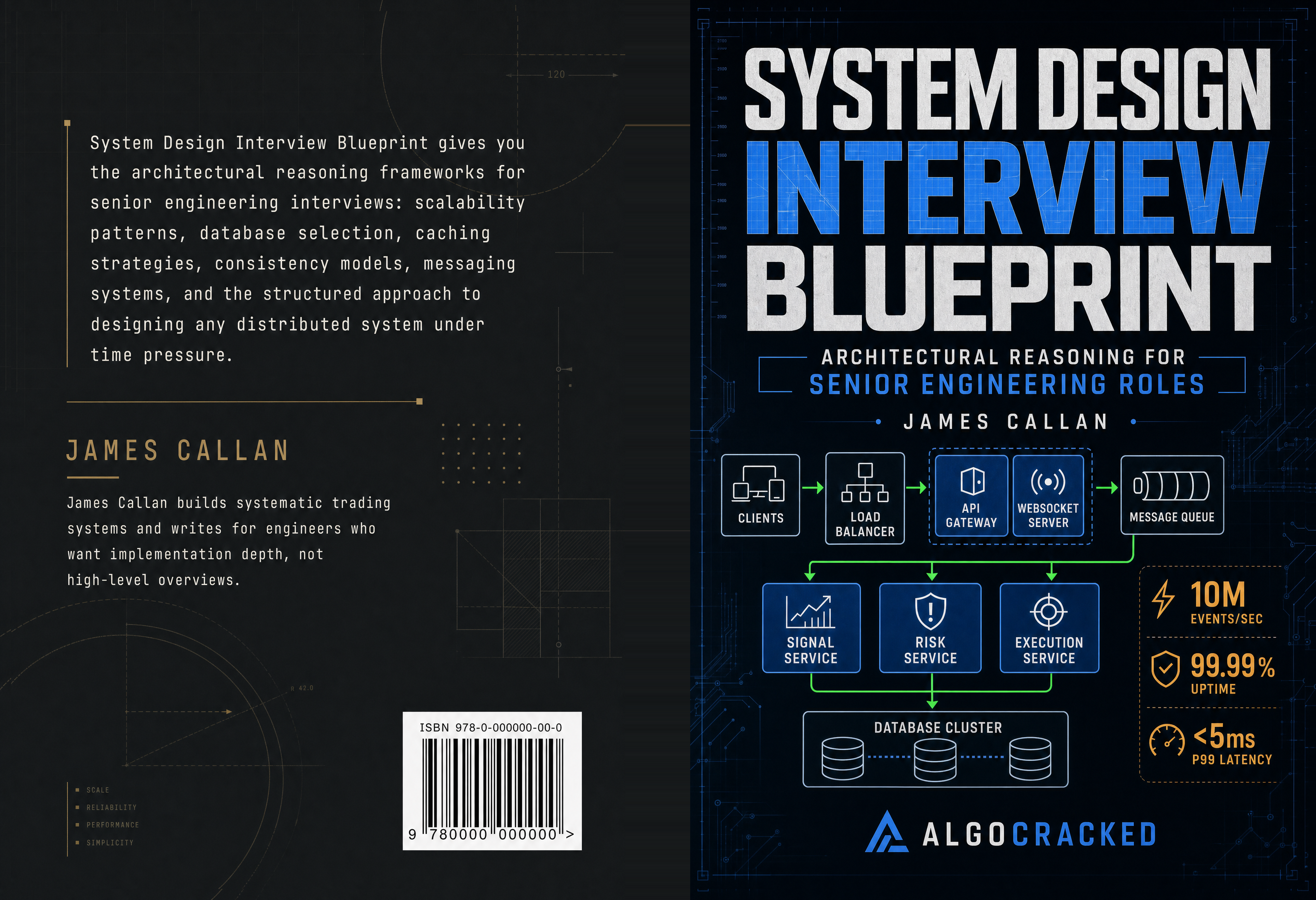
This book teaches you to reason through system design interviews using repeatable frameworks for requirements, scale estimation, tradeoffs, and architecture communication. By the end, you will have a personal design playbook with requirement templates, estimation habits, tradeoff matrices, and worked interview case studies.
Built for
A practical guide for mid-to-senior engineers preparing for system design interviews who need a repeatable framework, not a collection of memorized architectures.
What makes it useful
You will develop a structured approach to decomposing any system design problem, making defensible trade-off decisions, and communicating architectural reasoning clearly under interview pressure.
THE DIFFERENCE
Late book: end-to-end case studies, specialized depth in trading systems and distributed consensus.
A personal design playbook with requirement templates, estimation habits, tradeoff matrices, and worked interview case studies.
Apply the practical framework in Interview Framework and Requirements Clarification - Establish the repeatable opening moves of a strong design interview: clarifying scope, surfacing constraints.
Apply the practical framework in APIs, Gateways, and Core Service Boundaries - Teach how to move from requirements into clean service boundaries, interfaces, and request flows..
THE FULL BRIEF
This book teaches you to reason through system design interviews using repeatable frameworks for requirements, scale estimation, tradeoffs, and architecture communication. By the end, you will have a personal design playbook with requirement templates, estimation habits, tradeoff matrices, and worked interview case studies.
This book teaches you to reason through system design interviews using repeatable frameworks for requirements, scale estimation, tradeoffs, and architecture communication. By the end, you will have a personal design playbook with requirement templates, estimation habits, tradeoff matrices, and worked interview case studies.
What this book gives you: You will develop a structured approach to decomposing any system design problem, making defensible trade-off decisions, and communicating architectural reasoning clearly under interview pressure.
What you will be able to do:
Late book: end-to-end case studies, specialized depth in trading systems and distributed consensus.
A personal design playbook with requirement templates, estimation habits, tradeoff matrices, and worked interview case studies.
THE TABLE OF CONTENTS
Establish the repeatable opening moves of a strong design interview: clarifying scope, surfacing constraints, and structuring the conversation.
Teach the reader to estimate load, storage, and latency budgets quickly enough to guide architecture decisions under interview time pressure.
Teach how to move from requirements into clean service boundaries, interfaces, and request flows.
Delivered instantly after checkout.
EPUB
Delivered instantly after checkout.
Free preview
Read before you commit.
A personal design playbook covering 20+ system design scenarios with trade-off matrices, capacity estimation templates, and component selection rationale.
Apply the practical framework in Caching, CDNs, and Performance Layers - Teach the reader how to reduce latency and backend load through principled caching rather than vague performance folklore..
Apply the practical framework in Sharding, Multi-Region Design, and System Evolution - Teach how systems expand beyond single-node or single-region assumptions and how to explain those changes clearly..
Teach the reader to choose and justify storage systems according to access patterns, consistency needs, and scaling constraints.
Teach the reader how to reduce latency and backend load through principled caching rather than vague performance folklore.
Teach how to use asynchronous communication to increase resilience, throughput, and component isolation.
Teach the reader to reason explicitly about replication, failover, consistency tradeoffs, and the ways distributed systems degrade.
Teach how systems expand beyond single-node or single-region assumptions and how to explain those changes clearly.
Apply the framework to high-frequency interview prompts such as URL shorteners, social feeds, chat systems, and file storage.
Apply system design principles to trading-specific systems including order matching engines, market data distribution, risk engines, trade reconciliation, and regulatory reporting with sub-millisecond latency requirements.
Deepen understanding of CAP theorem beyond the basics including Dynamo vs Bigtable tradeoffs, partition tolerance strategies, Byzantine fault tolerance, split-brain recovery, and realistic failure cascades with worked incident analyses.
Convert architecture knowledge into interview performance through pacing, explanation structure, and self-review.

Instant Access
Available immediately after purchase
Secure Checkout
Payments processed by Stripe
